Sunday, January 30, 2011

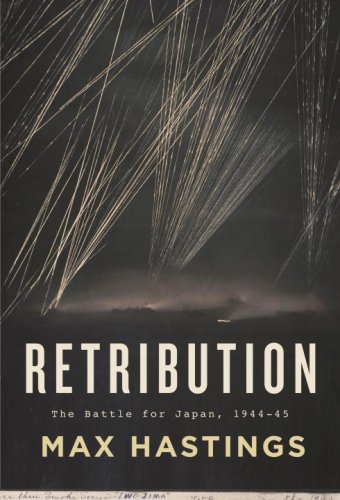
I read me some "Retribution"

I read me some Retribution: The Battle for Japan by Max Hastings. Retribution, similar to its counterpart Armageddon: The Battle for Germany, traces the last year of WWII in the Pacific. With the United States ascendent the conclusion of the war in the Pacific was a foregone conclusion to all save the Japanese and their leaders. Unfortunately, the last year brought untold pain and agony to millions throughout Asia and the Pacific. Millions perished as the Japanese clung to their empire and decided that what they couldn't hold they would kill.

The military battles in the Pacific have been well rehearsed by Spector and others, but few have attempted to encompass in one volume the full sweep of the Asian Theater, from the islands of the Pacific to SE Asia to the British slog through Burma to the Japanese victories in China to the last frenzied two week of the Russian invasion of Manchuria. Hastings does this and more, giving full weight to the horrors of the war.

And horror is what one comes away with after reading about the disasters in the Pacific. The Nazis are rightfully remembered for their inhumanity, but we forget the disdain for life that the Japanese demonstrated year after year, country after country. They raped, starved, and pillaged their way across Asia. They showed disdain for POWs (one statistic of note, 2.7% of POWs perished in German hands, while 37% of POWs died in Japanese hands) and for the life of their fellow countryman.

Hastings does an excellent job of helping the reader understand why the atomic was dropped. It is easy 66 years later to assume that there was another way, but as Hastings notes the Japanese leadership was in complete denial and would only agree to peace on their terms. Even after the a-bombs were dropped, significant number of Japanese officers wanted to fight until the bitter end.

This is a horrific book, but one all should read.
Sunday, December 19, 2010

Cash Transfers, Poverty, and Paternalism

Many monetary transfers* from the wealthy/middle class to the poor involve distinct policy bias and outcomes. For a variety of reasons most countries have decided to target assistance to the poor through specific programs rather than cash transfers. For example, in the United States we recognize that an advanced society shouldn't have "hungry" citizens so we provide foot stamps (SNAP) to qualifying families. Likewise, we understand that we want to limit the number of people on the streets so we subsidize rent (e.g., Section 8) and heating bills (LIHEAP). We do this because we want to make sure our "money" is being spent on the intended policy outcome. This policy of targeted assistance leads to significant costs for our government and the people receiving the assistance (deadweight loss).

If we wanted to be much more economically efficient we would institute a policy of strict cash transfers. Thus, rather than giving $100 in vouchers the government would give $100 in greenbacks (and save on government overhead). As Matthew Yglesias states:
It sounds banal when you say it, but one of the main obstacles to people being less poor is that they don’t have enough money. If you give them money, they’ll have more of it. Will this be optimal in all cases? Of course not. But in the vast majority of cases, you’ll do some good. 
I agree with Yglesias that cash transfers are better and think that individuals are better at making decisions than the government, however, he and others have failed to highlight the one significant problem with cash transfers--living with the consequences.

Could we actually live with the consequences of program that though more efficient leads to "some" people make really bad choices and publicly suffering the consequences? Would we be able to say, "Well, he had his money, but decided to spend it on something else?" I don't think so (and to be fair I don't think Yglesias thinks so either). We want to talk tough, but like many things in the policy world, decisions are hard and all have consequences--foreseen or otherwise.

Tuesday, December 14, 2010

My Lack of Education

I'm a nerd, plain and simple. I like facts of all sorts and kinds. Facts about maps, facts about the distance between stars, facts about Peruvian llamas, facts about farm policy. As a child I read fact books before I drifted off to sleep. I might not have been the fastest kid or the cutest, but I did know lots of things about lots of stuff.

Unfortunately, as I've aged I've come to see a lacking in my education. I could talk to you for hours about the formation of mountains and the water cycle and the dominance of ferns during the age of dinosaurs. However, during a walk in the woods I wouldn't be able to tell an elm from an ash. The difference between a hydrangea from and a rhodendrum is greek to me. Socrates was done in by hemlock, but I couldn't tell you if I was eating a hemlock leaf right now.

This new awareness comes from my reading of Roger Deakin's Wildwood. In this fantastic book he traces his journey through his local (and far off) wood. And with me he is leading a blind man.

Monday, December 13, 2010

I Read Me Some "Battle Cry of Freedom"

On work trip to Sioux Falls a month ago I had joyful the opportunity to peruse a local used bookshop. Unfortunately, I have inherited from my father the need/compulsion to leave any bookstore with a new book. So I left the store with McPherson's Battle Cry of Freedom, a one volume history of the United States Civil War.

Over 800 pages McPherson covers the social and military history of the Civil War. He explains not only the hows and whats, but also the whys. And as we approach the 150th anniversary of the Civil War more and more talk has been had about the causes for the Civil War. Some talk, alas, has veered into complete silliness with slogans that the War was about "State Rights" and "Protecting Liberty" and "Fighting for the Homeland."

Of course, that's bunk. "State's Rights"only works in the sense that the state's seceded for the right to own slaves. To quote from Mississippi's "Causes of Secession" of 1861:

In the momentous step, which our State has taken of dissolving its connection with the government of which we so long formed a part, it is but just that we should declare the prominent reasons which have induced our course.
Our position is thoroughly identified with the institution of slavery - the greatest material interest of the world. 
Or from South Carolina:
The General Government, as the common agent, passed laws to carry into effect these stipulations of the States. For many years these laws were executed. But an increasing hostility on the part of the non-slaveholding States to the institution of slavery, has led to a disregard of their obligations, and the laws of the General Government have ceased to effect the objects of the Constitution.  
The Civil War was a horror for all involved. But it is important to remember why the states seceded.

Monday, November 29, 2010

Advent

Rowan Williams:
We turn our minds to the universal longing for God that is given voice in the Jewish scripture, the yearning towards the 'desire of all nations' ... For the people of God in Jewish scripture, loyalty to the covenant meant above all the forsaking of idols: the task is not to make sense of the world, beginning from unaided human resource, but to let ourselves be given sense purely by the summons of God. This was Israel's own story: being led out of slavery and given shape and solidity by the unexpected presence and pressure of God ... And in Advent, in that day, we all become - as it has been said - Jews once more ... We are perpetually looking to and giving thanks for an uncovenanted event, a transforming newness, the history of Israel and Jesus; we are perpetually 'on the eve' of God's coming, knowing and not knowing what it will be ... Advent, we have said, sets out before us the richness of religious eros; it is a season of beautiful, elegiac hymns, voicing our longing to be spoken to, judged and absolved. But in its deeper aspect, its pushing of us back into the experience of Israel and Israel's unconsoled rejection of idols, it also shows us also the danger of religious eros, its capacity to become another vehicle for human self-reflection. The Christian, in the Advent season above all, must learn something of God's own simultaneous 'yes' and 'no' to all religious aspiration and expectation.
HT: More than a via media

A Christmas Song by Sufjan

Monday, November 22, 2010

A Real Business Sense

From the Comments of the previous post that should be brought to our attention:
Egg Farmer needs to clarify... It is section 179 depreciate, not accelerated depreciation that is a problem. Section 179 allows businesses to completely write off a new piece of equipment. The state of minnesota does not allow the deduction or only a portion of the total amount the federal section 179 allows. If a business person cannot take it both on the federal and state, what is the point... In our case we don't take the full amount of section 179 tax deduction, because it doesn't help on the state tax return. Of course, my good friend across the state line can take the section 179 both on the state and federal tax. All these different tax deductions and/or incentives that are given to businesses I understand (we take advantage of as many as we can). The problem is that the playing field becomes uneven. I am not arguing that the government should some how make it "even" or "fair" for all, because innovation and technology will always disrupt the playing field. What I think the role of government can or should play is to use its limited resources in shaping a better playing field (better infrastructure, simplifying the tax code and security), which would benefit all.
A few thoughts. First, it is easy for the folks who don't run a company to see the day to day effects of our taxation policy. How we tax matters. Second, if I ever want to run a small business, boy I need an education. Third, I'd be interested in Egg Farmer's take, do you think that services you get in MN (better infrastructure, better schools, etc) and the closer proximity to large population centers outweigh the higher taxes? Life is full of trade offs (no matter what Congress says), so is this a worthwhile trade off?

Sunday, November 21, 2010

The BET!

I was talking to Egg Farmer in Cokato the other day about the topics of the day: taxes, federal budgets, and egg prices. As a businessman Egg Farmer in Cokato had lots of insight into taxes, particularly how a lack of harmonization between federal and state taxes create different incentives (e.g., the feds allow a business to accelerate the depreciation of an asset--say new packing equipment--encouraging the business to purchase expensive items and then deduct the cost from it's taxes. Minnesota does not allow a business to do that).

Anyway, EFIC is much more pessimistic than me. I said that the USA will hit a significant budgetary crisis because of every rising deficits, while he says it will happen within in 10 years. Thus, a bet is born. For a six pack of beer we decided to bet on the timing of a significant budgetary crisis. The definition of the crisis will be a point of time in which the US Congress will need to balance the budget (for the fiscal year) because of significant financial pressures. If this crisis happens before Dec 31, 2019, Egg Farmer in Cokato wins. If after, Redhead in Rapid wins. The bet is a bit wooly, but we think we can agree when we see the crisis unfold before our eyes.

Monday, November 8, 2010

Good News of the Day

It is easy to see man a hard scrabbled creature willing to cut any throat to seize the day. So here is my good news to consider, from The Best Defense:
With Colombia now moving toward peace, there are hardly any wars underway in the western hemisphere, notes Fettweis, a political scientist who used to teach at the Naval War College and now slings international relations at Tulane University. Europe is at peace -- and barely has any militaries anyway. The Pacific Rim has two billion people and no fighting, quite an achievement. Asia's only conflict last year was the nasty little Sri Lankan civil war, which is over. The wars that are occurring are long-term affairs on low boil, such as the Israeli-Palestinian standoff, the Yemeni fighting, and, of course, the United States' messes in Iraq and Afghanistan.

Me in 5 Years

Copyright: Mr. Thompson