"Right now, in your mouth, in your gut, on your skin, you are carrying about 10 times more bacteria cells than human cells."
-Robert Krulwich
Friday, June 10, 2011

Wading Into That Which I Don't Know or Really Care
This last Tuesday I saw X-Men: First Class. It was a well acted, though slow movie, with a few too many characters. Matthew Yglesias has pointed out that Magneto was Right and really right. He says, "if you restrict your attention to what’s actually in the text Magneto is clearly in the right and Xavier’s X-Men are a bunch of dupes." And goes on to say:
The problem is that for Magneto, mutant is a separate species and category than human. He's not addressing the issue as a minority normally would be, "I am part of society and am fully human." Instead Magneto argues that mutants are beyond super human, are a new species, and thus should dominate the world. Sure Xavier is naive, but he wants to see the humanness in mutants and wants humans to see mutants as humans. I don't know why that's a bad thing.
Magneto’s mutant pride attitude is in every way more admirable than Xavier’s preference for the closet, and Xavier’s political view that mutants and humans can coexist peacefully if mutants avoid provocations is directly contradicted by the events at the end of the film. When Xavier is trying to convince Magneto (and the audience) that Magneto’s more militant methods will cost innocent life he literally says—to a Holocaust survivor!—that “they were only following orders” and therefore their sins are forgivable.
Not surprisingly I don't really agree with this analysis. I see the point he is trying to make and it is an allowable reading of the movie, but it misses out on the methods that Magneto wants to use to meet his end of Mutant Pride and his mistaken view of what it means to be human.
The mutant pride message is a radical one. It’s too radical for those whose WASP male privilege in their non-mutant lives makes them instinctively want to identify with existing power structures. But a mutant who’s also a Jew, or a woman, or a racial minority, or has had blue or red skin all of his or her life doesn’t suffer from that kind of false consciousness and gets ahead of the curve.
The problem is that for Magneto, mutant is a separate species and category than human. He's not addressing the issue as a minority normally would be, "I am part of society and am fully human." Instead Magneto argues that mutants are beyond super human, are a new species, and thus should dominate the world. Sure Xavier is naive, but he wants to see the humanness in mutants and wants humans to see mutants as humans. I don't know why that's a bad thing.
Sunday, June 5, 2011
Preaching Day...
Today I had the opportunity to preach at Hope Christian Reformed. For the scripture I selected 1 Peter 3:13-18, focusing on the line, "if someone asks about your Christian hope, always be ready to explain it.” The funny thing about Christian Hope is that it is such a back/forward expectation. It's like how light behaves as understood by quantum physics--it is both a wave and a particle. Measure it one way and you get a nice wave of light, but measured another, you get little packets of information.
With Christian Hope the resurrection of Jesus and our future resurrection happens at the same time. You can't separate them without breaking the thing itself. We look back to the Jesus' resurrection and look forward to our resurrection because of what Jesus has done. A funny little hopeful thing.

With Christian Hope the resurrection of Jesus and our future resurrection happens at the same time. You can't separate them without breaking the thing itself. We look back to the Jesus' resurrection and look forward to our resurrection because of what Jesus has done. A funny little hopeful thing.

Monday, May 30, 2011
Bad Economic News of the Day
Well we know that the economy is not improving nearly as well as we hoped, particularly 3 years on. Unfortunately, it's getting worse, or is worse then they say. From Henry Blodget:
The way the government calculates real GDP is to start with nominal GDP--the actual change in the output of the economy as measured by adding up all the actual sales prices ("nominal")--and then "deflating" this number by subtracting an estimated inflation rate. Thus, the government backs into the real GDP growth number, starting with nominal prices and then adjusting for inflation.
Well, the "GDP deflater" the government is using right now--the estimated rate of inflation--is only 1.9%. As anyone who has been to a supermarket of gas station recently can attest, this assumption is preposterously low. But the effect on "GDP growth" of using a very low inflation estimate is helpful, in that it makes real GDP growth look bigger.
So what would Q1 GDP have looked like if the government had used the government's own estimate of inflation for Q1 (5.7%), instead of 1.9%?
Q1 GDP would have been -1.82%.Not good.
Where is your hope?
Hey folks, I get to preach this Sunday and will be talking about our Christian Hope (1 Peter 3:14-17). I'm wondering, where is your hope? Christian or otherwise?
Back at it... Barely
The kid has come and is getting bigger every day. I should be back blogging, so I am. I'm hoping to get two posts completed each week. I think the best way to celebrate is a double rainbow.


Or
Sunday, January 30, 2011
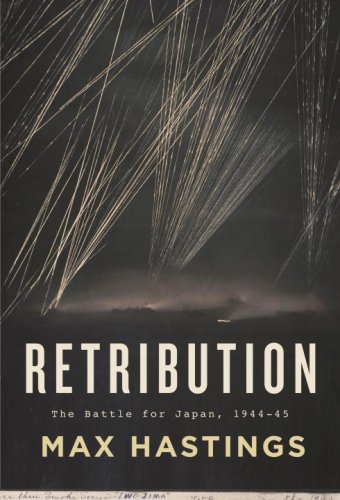
I read me some "Retribution"
I read me some Retribution: The Battle for Japan by Max Hastings. Retribution, similar to its counterpart Armageddon: The Battle for Germany, traces the last year of WWII in the Pacific. With the United States ascendent the conclusion of the war in the Pacific was a foregone conclusion to all save the Japanese and their leaders. Unfortunately, the last year brought untold pain and agony to millions throughout Asia and the Pacific. Millions perished as the Japanese clung to their empire and decided that what they couldn't hold they would kill.
The military battles in the Pacific have been well rehearsed by Spector and others, but few have attempted to encompass in one volume the full sweep of the Asian Theater, from the islands of the Pacific to SE Asia to the British slog through Burma to the Japanese victories in China to the last frenzied two week of the Russian invasion of Manchuria. Hastings does this and more, giving full weight to the horrors of the war.
And horror is what one comes away with after reading about the disasters in the Pacific. The Nazis are rightfully remembered for their inhumanity, but we forget the disdain for life that the Japanese demonstrated year after year, country after country. They raped, starved, and pillaged their way across Asia. They showed disdain for POWs (one statistic of note, 2.7% of POWs perished in German hands, while 37% of POWs died in Japanese hands) and for the life of their fellow countryman.
Hastings does an excellent job of helping the reader understand why the atomic was dropped. It is easy 66 years later to assume that there was another way, but as Hastings notes the Japanese leadership was in complete denial and would only agree to peace on their terms. Even after the a-bombs were dropped, significant number of Japanese officers wanted to fight until the bitter end.
This is a horrific book, but one all should read.
Sunday, December 19, 2010
Cash Transfers, Poverty, and Paternalism
Many monetary transfers* from the wealthy/middle class to the poor involve distinct policy bias and outcomes. For a variety of reasons most countries have decided to target assistance to the poor through specific programs rather than cash transfers. For example, in the United States we recognize that an advanced society shouldn't have "hungry" citizens so we provide foot stamps (SNAP) to qualifying families. Likewise, we understand that we want to limit the number of people on the streets so we subsidize rent (e.g., Section 8) and heating bills (LIHEAP). We do this because we want to make sure our "money" is being spent on the intended policy outcome. This policy of targeted assistance leads to significant costs for our government and the people receiving the assistance (deadweight loss).
If we wanted to be much more economically efficient we would institute a policy of strict cash transfers. Thus, rather than giving $100 in vouchers the government would give $100 in greenbacks (and save on government overhead). As Matthew Yglesias states:
Could we actually live with the consequences of program that though more efficient leads to "some" people make really bad choices and publicly suffering the consequences? Would we be able to say, "Well, he had his money, but decided to spend it on something else?" I don't think so (and to be fair I don't think Yglesias thinks so either). We want to talk tough, but like many things in the policy world, decisions are hard and all have consequences--foreseen or otherwise.
If we wanted to be much more economically efficient we would institute a policy of strict cash transfers. Thus, rather than giving $100 in vouchers the government would give $100 in greenbacks (and save on government overhead). As Matthew Yglesias states:
It sounds banal when you say it, but one of the main obstacles to people being less poor is that they don’t have enough money. If you give them money, they’ll have more of it. Will this be optimal in all cases? Of course not. But in the vast majority of cases, you’ll do some good.I agree with Yglesias that cash transfers are better and think that individuals are better at making decisions than the government, however, he and others have failed to highlight the one significant problem with cash transfers--living with the consequences.
Could we actually live with the consequences of program that though more efficient leads to "some" people make really bad choices and publicly suffering the consequences? Would we be able to say, "Well, he had his money, but decided to spend it on something else?" I don't think so (and to be fair I don't think Yglesias thinks so either). We want to talk tough, but like many things in the policy world, decisions are hard and all have consequences--foreseen or otherwise.
Tuesday, December 14, 2010
My Lack of Education
I'm a nerd, plain and simple. I like facts of all sorts and kinds. Facts about maps, facts about the distance between stars, facts about Peruvian llamas, facts about farm policy. As a child I read fact books before I drifted off to sleep. I might not have been the fastest kid or the cutest, but I did know lots of things about lots of stuff.
 Unfortunately, as I've aged I've come to see a lacking in my education. I could talk to you for hours about the formation of mountains and the water cycle and the dominance of ferns during the age of dinosaurs. However, during a walk in the woods I wouldn't be able to tell an elm from an ash. The difference between a hydrangea from and a rhodendrum is greek to me. Socrates was done in by hemlock, but I couldn't tell you if I was eating a hemlock leaf right now.
This new awareness comes from my reading of Roger Deakin's Wildwood. In this fantastic book he traces his journey through his local (and far off) wood. And with me he is leading a blind man.
Subscribe to:
Posts (Atom)