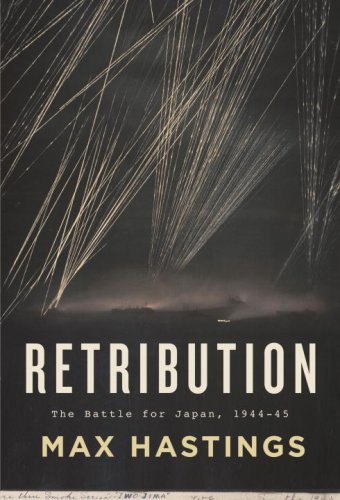
I read me some Retribution: The Battle for Japan by Max Hastings. Retribution, similar to its counterpart Armageddon: The Battle for Germany, traces the last year of WWII in the Pacific. With the United States ascendent the conclusion of the war in the Pacific was a foregone conclusion to all save the Japanese and their leaders. Unfortunately, the last year brought untold pain and agony to millions throughout Asia and the Pacific. Millions perished as the Japanese clung to their empire and decided that what they couldn't hold they would kill.
The military battles in the Pacific have been well rehearsed by Spector and others, but few have attempted to encompass in one volume the full sweep of the Asian Theater, from the islands of the Pacific to SE Asia to the British slog through Burma to the Japanese victories in China to the last frenzied two week of the Russian invasion of Manchuria. Hastings does this and more, giving full weight to the horrors of the war.
And horror is what one comes away with after reading about the disasters in the Pacific. The Nazis are rightfully remembered for their inhumanity, but we forget the disdain for life that the Japanese demonstrated year after year, country after country. They raped, starved, and pillaged their way across Asia. They showed disdain for POWs (one statistic of note, 2.7% of POWs perished in German hands, while 37% of POWs died in Japanese hands) and for the life of their fellow countryman.
Hastings does an excellent job of helping the reader understand why the atomic was dropped. It is easy 66 years later to assume that there was another way, but as Hastings notes the Japanese leadership was in complete denial and would only agree to peace on their terms. Even after the a-bombs were dropped, significant number of Japanese officers wanted to fight until the bitter end.
This is a horrific book, but one all should read.
Showing posts with label War. Show all posts
Sunday, January 30, 2011
Monday, March 15, 2010
My Summary of Why the Brits Lost the Revolutionary War OR Why Education Can Make You Think You Know More Than You Do
Back in my former life I took a class on Strategy and War. Like many papers I've written in college and grad school I was way over my head. Fortunately my confidence would not be shaken. Here is the opening salvo:
Thirty years after the Jacobite Rebellion of 1745 the King and his government faced another rebellion. This time, three thousand miles away, a select group of American colonists were agitating for independence. The implicit question before Parliament was what kind of war was it fighting. Was it a rebellion that needed to be put down or a war where success would mean less than the status quo? Unfortunately, for Parliament and the crown, the British leaders chose poorly. In the colonists they saw illegitimate agitators seeking to break apart the empire. In choosing a rebellion that needed to be repressed the British leaders lost the war. Despite numerous victories in battle, America was lost. Events in America did little to change strategy in London. No British general was able to translate the subtleties of events in the theater of war for the ears of the cabinet.
Throughout the war British leaders were unable (or for some, unwilling) to reassess their strategy because they didn’t understand the nature of the conflict. And they didn’t understand the conflict because (1) British leaders in power were unable to comprehend the American people and their cause, (2) which when filtered through the British political structure inhibited clear policies and obtainable political objectives, and led to (3) a lack of coordination between military actions and political ends. Ultimately what inhibited British leaders from reassessing their strategy was the interaction between the government and military, exacerbated by incomprehension. They couldn’t see the forest for the trees because they thought they were sailing in the open ocean.
Subscribe to:
Posts (Atom)
